

Google Ads campaigns are a powerful tool for reaching your target audience and increasing conversions. One key factor in the success of your Google Ads campaign is selecting the right keywords. In this blog post, we will explore the importance of targeted keywords for CRM success and how you can master Google Ads to effectively reach your audience and drive results. By understanding the significance of choosing the right keywords, you can optimize your campaign and achieve your CRM goals with precision and efficiency.
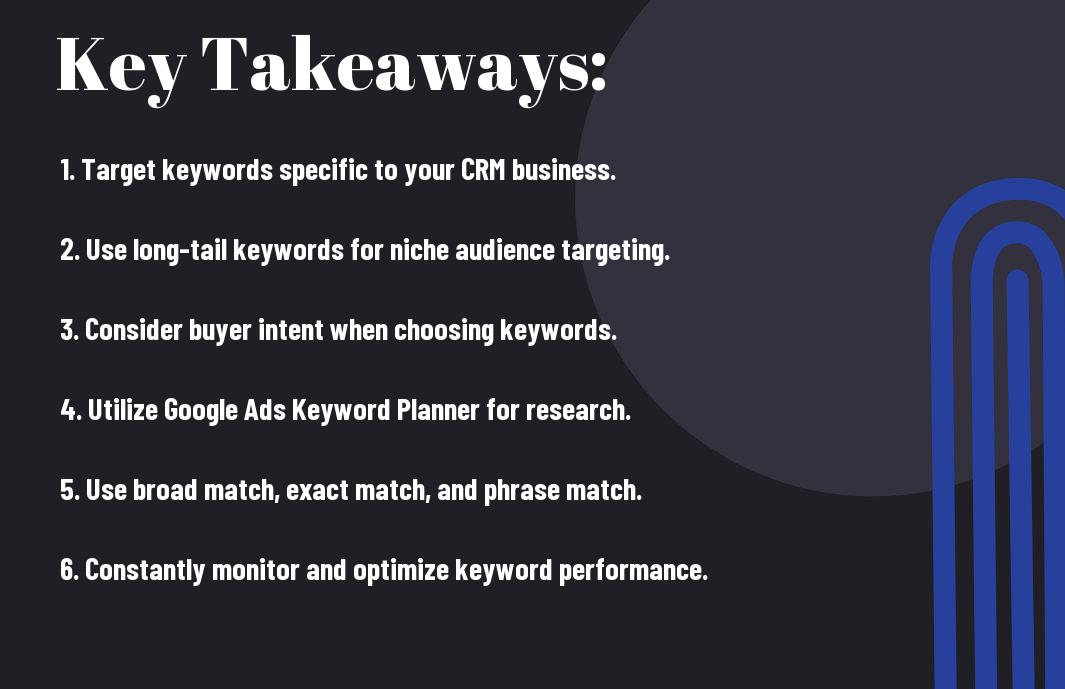
Key Takeaways:
- Understanding Match Types: It is crucial to comprehend the different match types (Broad match, Phrase match, Exact match, and Negative keywords) to effectively target keywords in Google Ads.
- Keyword Relevance: Ensure your keywords are highly relevant to your ad copy and landing page to improve Quality Score and ad performance.
- Long-Tail Keywords: Target long-tail keywords to reach a more specific audience and improve conversion rates.
- Keyword Research Tools: Utilize tools like Google Keyword Planner, SEMrush, and Keywords Everywhere to conduct thorough keyword research and identify relevant keywords for your campaigns.
- Competitor Analysis: Analyze your competitors’ keyword strategies to uncover new keyword opportunities and stay ahead in the competitive landscape.
- Dynamic Keyword Insertion: Implement dynamic keyword insertion in your ads to increase ad relevance and attract more clicks from potential customers.
- Regular Monitoring and Optimization: Continuously monitor the performance of your keywords, make necessary adjustments, and optimize your campaigns to drive better results and maximize ROI.
Understanding the Foundation of Google Ads for CRM
The Role of Google Ads in Customer Relationship Management
The foundation of Google Ads in Customer Relationship Management (CRM) lies in its ability to target specific keywords that are relevant to your business and customer base. By leveraging Google Ads, you can reach potential customers who are actively searching for products or services that align with your CRM strategy.
Integrating Google Ads with Your CRM Strategy
For successful CRM implementation, it is imperative to integrate Google Ads with your CRM strategy. This integration allows you to capture valuable data on customer interactions and behaviors, which can then be used to tailor your Google Ads campaigns for maximum impact.
The synergy between Google Ads and CRM can result in a highly targeted marketing approach that not only attracts new customers but also nurtures existing relationships for long-term success.
Identifying and Selecting Targeted Keywords
Conducting Effective Keyword Research for CRM
Selecting the right keywords for your CRM campaign is crucial for reaching your target audience effectively. Start by conducting thorough keyword research to identify the terms and phrases that your potential customers are searching for. Use tools like Google Keyword Planner, SEMrush, or Ahrefs to uncover relevant keywords with high search volume and low competition.
Utilizing Keyword Match Types to Your Advantage
Regarding utilizing keyword match types in your Google Ads campaigns, understanding the differences between broad match, phrase match, exact match, and broad match modifier is imperative. Each match type has its own set of advantages and limitations, so it’s important to choose the right match type based on your campaign goals and target audience. Incorporating a mix of match types can help you reach a wider audience while maintaining control over your ad targeting.
On this note, it is imperative to understand the nuances of each keyword match type to leverage them effectively in your CRM campaigns. Here is a breakdown of the key differences:
| Match Type | Description |
|---|---|
| Broad Match | Ads may show on searches that include misspellings, synonyms, related searches, and other relevant variations. |
| Phrase Match | Ads may show on searches that match a phrase, with additional words before or after. |
| Exact Match | Ads may show on searches that exactly match the keyword or are close variations of that exact term. |
| Broad Match Modifier | Ads may show on searches that include the modified term (or close variations), but not synonyms. |
| Negative Match | Ads will not show on searches containing the specified term, allowing you to exclude irrelevant traffic. |
This comprehensive understanding of keyword match types will empower you to create targeted and effective Google Ads campaigns that align with your CRM objectives. Bear in mind, precision in keyword selection is key to maximizing your ad spend and driving quality leads. Thou shall wield the power of keyword match types strategically to optimize your campaign performance and achieve sustainable CRM success.
Crafting High-Performing Google Ads Campaigns
Designing Compelling Ad Copy That Resonates with Your CRM Goals
One of the key elements in a successful Google Ads campaign is crafting ad copy that speaks directly to your CRM goals. By aligning your messaging with your customer relationship management objectives, you can create ads that resonate with your target audience and drive them to take the desired action. Use clear and concise language that highlights the benefits of your product or service in relation to your CRM strategy, prompting users to click through and engage with your business.
Optimizing Landing Pages for Higher Conversion Rates
Campaigns to optimize landing pages for higher conversion rates are crucial for the success of your Google Ads strategy. Ensure that your landing pages are tailored to the specific needs and interests of your CRM audience. By focusing on relevance, clarity, and a strong call to action, you can increase the likelihood of converting ad clicks into valuable leads or customers. Implementing A/B testing, tracking performance metrics, and continuously refining your landing page content will help maximize your campaign’s effectiveness.
Compelling Landing pages are crucial components of a successful Google Ads campaign. They serve as the first point of contact for potential customers who have clicked on your ad, making it necessary to design them with your CRM goals in mind. By creating landing pages that are optimized for conversions, you can guide visitors towards taking the desired action, whether it’s making a purchase, signing up for a demo, or requesting more information. Focus on creating engaging, user-friendly experiences that reinforce the messaging from your ads and provide a seamless journey for your CRM-targeted audience.

Measuring Success and Optimizing Performance
Key Performance Indicators to Track for CRM Success
For a successful CRM campaign, it is imperative to track key performance indicators (KPIs) that directly impact the success of your Google Ads strategy. KPIs such as conversion rates, click-through rates, cost per acquisition, and return on ad spend are crucial metrics to monitor to ensure your campaigns are effectively driving results and meeting your CRM goals.
A/B Testing and Continuous Improvement of Google Ads Campaigns
Performance optimization is key to maximizing the effectiveness of your Google Ads campaigns for CRM success. A/B testing allows you to compare different ad variations to determine which performs better in terms of engagement and conversions. By continuously testing and tweaking your ads, you can improve their performance over time and drive better results for your CRM efforts.
Plus, by analyzing the results of your A/B tests, you can gain valuable insights into your target audience’s preferences and behaviors, allowing you to refine your targeting and messaging for better engagement and conversion rates. This iterative approach to campaign optimization is imperative for staying competitive in the ever-evolving landscape of digital advertising.
Advanced Tactics for Enhancing CRM Outcomes with Google Ads
All successful Google Ads campaigns require a strategic approach to maximize CRM outcomes. To master the art of Google Ads, it’s important to implement advanced tactics that can significantly impact your CRM success. For a comprehensive guide on mastering Google Ads campaigns, check out our 7 Tips for Mastering Google Ads Campaigns.
| Retargeting Strategies | Audience Segmentation and Personalization |
Retargeting Strategies to Increase CRM Engagement
Strategies for retargeting involve reaching out to users who have previously interacted with your CRM system but did not convert. By showing relevant ads to these users as they browse the web, you can increase engagement and encourage them to return to complete their purchase or take the desired action.
Leveraging Audience Segmentation and Personalization
Strategies for leveraging audience segmentation and personalization involve dividing your target audience into specific segments based on demographics, behavior, or interests. By tailoring your ads to each segment’s needs and preferences, you can deliver more personalized messaging that resonates with users, ultimately leading to higher conversion rates and better CRM outcomes.
Final Words
Presently, mastering targeted keywords is important for CRM success through Google Ads. By understanding the significance of using strategic keywords that resonate with your audience, you can efficiently reach potential customers and drive conversions. Incorporating the right keywords into your ad campaigns can significantly impact the success of your CRM strategy. Stay updated with the latest trends and constantly refine your keyword lists to ensure maximum effectiveness. With focus and diligence, you can optimize your Google Ads campaigns for CRM success and achieve your marketing goals.
FAQ
Q: What is Google Ads Mastery?
A: Google Ads Mastery is a comprehensive program that focuses on leveraging targeted keywords to achieve success in CRM (Customer Relationship Management) through Google Ads campaigns.
Q: Why is targeting keywords important in Google Ads?
A: Targeting keywords in Google Ads is crucial because it allows you to reach the right audience who are actively searching for your products or services, increasing the chances of conversions and maximizing ROI.
Q: How can targeted keywords improve CRM success?
A: By using targeted keywords in Google Ads, you can attract high-quality leads, engage with potential customers at the right moment, and drive them through the sales funnel, ultimately leading to better CRM success.
Q: What are some best practices for selecting targeted keywords in Google Ads?
A: To select targeted keywords effectively, conduct thorough keyword research, analyze competitor keywords, use long-tail keywords for specificity, continuously monitor and optimize keyword performance, and align keywords with your CRM goals.
Q: How can I measure the effectiveness of targeted keywords in Google Ads for CRM success?
A: You can measure the effectiveness of targeted keywords by tracking key performance indicators (KPIs) such as click-through rates, conversion rates, cost per acquisition, return on ad spend, and overall CRM impact to gauge the success of your Google Ads campaigns.
Q: What are some common pitfalls to avoid when using targeted keywords in Google Ads?
A: Common pitfalls to avoid include targeting irrelevant keywords, using broad match keywords that may attract low-quality traffic, neglecting negative keywords, not refining keyword lists regularly, and not analyzing data to make informed decisions.
Q: How can I stay updated on the latest trends and changes related to targeted keywords in Google Ads?
A: Stay updated on the latest trends by following Google Ads blogs, attending industry conferences and webinars, joining online communities or forums, subscribing to newsletters, and continuously learning through online courses or certifications focused on Google Ads and keyword targeting strategies.