

Many website owners understand the importance of creating SEO optimized content to improve their visibility and ranking on search engine results pages. Crafting content that resonates with both human readers and search engine algorithms is crucial for driving organic traffic to your site. To achieve this, there are several best practices that you should keep in mind when writing for your website blog.
One of the most important aspects of SEO optimized content writing is conducting thorough keyword research. By identifying and strategically incorporating relevant keywords into your blog posts, you can improve your chances of ranking higher in search results. Additionally, structuring your content with headings, subheadings, and meta tags can enhance readability for both users and search engines, ultimately boosting your site’s visibility. It is also crucial to prioritize high-quality, original content that provides value to your audience, as this can help establish your website as a reliable source within your industry.
Ignoring SEO best practices when creating content for your website blog can be detrimental to your online presence. Failure to optimize your content can result in poor search engine rankings, decreased organic traffic, and ultimately, lower engagement with your target audience. By following these best practices and staying updated on the latest SEO trends, you can enhance the visibility and credibility of your website blog, ultimately driving success for your online business.
Key Takeaways:
- Keyword Research: Conduct thorough keyword research to identify relevant keywords with high search volume and low competition.
- High-Quality Content: Create engaging, informative, and well-researched content that adds value to your target audience.
- Optimized Headings and Subheadings: Use relevant keywords in headings and subheadings to improve readability and SEO optimization.
- Meta Tags and Meta Descriptions: Write compelling meta tags and meta descriptions that include target keywords to improve click-through rates from search results.
- Internal and External Linking: Include both internal and external links in your content to improve SEO and provide additional value to readers.
- Mobile-Friendly Content: Ensure your content is optimized for mobile devices to improve user experience and SEO rankings.
- Regularly Update Content: Update and refresh your content regularly to keep it relevant, accurate, and in line with current SEO best practices.
Understanding SEO Ranking Factors
There’s no doubt that SEO ranking factors play a crucial role in determining where your website stands on search engine result pages. By understanding these factors, you can optimize your content to improve your visibility and attract more organic traffic. Here are some key points to keep in mind:
- Keywords: Using relevant keywords strategically throughout your content is important for ranking higher on search engines.
- Quality Content: Creating high-quality, engaging content that provides value to your audience can help improve your SEO rankings.
- Backlinks: Building a strong backlink profile with reputable websites can signal to search engines that your content is trustworthy and authoritative.
Knowing how these factors interplay and affect your website’s ranking can help you create SEO-optimized content that drives traffic and boosts your online presence.
Core Elements of SEO
Ranking well on search engine result pages requires a deep understanding of the core elements of SEO. These elements include on-page optimization, off-page optimization, and technical SEO. On-page optimization involves optimizing your content with relevant keywords, meta tags, and headings. Off-page optimization focuses on building quality backlinks from other websites to establish your site’s authority. Technical SEO ensures your website is user-friendly, accessible, and easily crawlable by search engines.
Understanding and implementing these core elements can greatly improve your website’s visibility and search engine rankings, ultimately driving more organic traffic to your site.
The Role of Google’s Algorithm Updates
The landscape of SEO is constantly evolving, largely due to Google’s algorithm updates. These updates aim to improve user experience and provide more relevant and accurate search results. However, these updates can also have a significant impact on website rankings, often causing fluctuations in search engine rankings for many websites.
Understanding how Google’s algorithm updates work and staying informed about the latest changes is crucial for maintaining and improving your website’s SEO performance. By adapting your SEO strategies in response to these updates, you can ensure that your website remains competitive in the ever-changing digital landscape.
Keyword Research Strategies
Importance of Keyword Relevance
Clearly, one of the most crucial aspects of SEO optimized content writing is keyword relevance. When creating content for your website blog, it is important to ensure that the keywords you are targeting are relevant to your business, industry, and target audience. Using relevant keywords helps search engines understand what your content is about and improves the chances of your website ranking higher in search results. This can lead to increased organic traffic and better visibility for your website.
Implementing strategies to maintain keyword relevance involves thorough research and analysis of your target keywords. By understanding the intent behind specific keywords, you can tailor your content to meet the needs and expectations of your audience. This not only improves your search engine rankings but also enhances the overall user experience on your website.
Furthermore, focusing on keyword relevance allows you to stay competitive in your industry by targeting the right audience with the right content. By aligning your keywords with your business objectives and target market, you can attract quality leads and drive conversions effectively.
Tools and Techniques for Effective Keyword Research
Keyword research is a critical component of SEO optimized content writing. It involves identifying the most relevant and high-traffic keywords that your target audience is using to search for information online. There are various tools and techniques available to help you conduct effective keyword research, such as keyword research tools, competitor analysis, and trend analysis.
By utilizing keyword research tools like SEMrush, Ahrefs, and Google Keyword Planner, you can identify valuable keywords that have high search volume and low competition. These tools provide valuable insights into keyword trends, search volume data, and competition analysis, helping you make informed decisions about which keywords to target in your content.
Additionally, conducting competitor analysis allows you to see which keywords your competitors are ranking for and identify opportunities to target similar keywords in your content. This competitive insight can help you refine your keyword strategy and stay ahead of the competition in search engine rankings.
Importance: When conducting keyword research for your website blog, it is necessary to focus on long-tail keywords. These keywords are more specific and targeted, making it easier to rank for them compared to broad, generic keywords. Long-tail keywords also attract more qualified leads as they reflect the user’s intent more accurately, resulting in higher conversion rates.
Long-Tail vs. Short-Tail Keywords
Keywords play a crucial role in determining the success of your SEO optimized content writing strategy. While short-tail keywords may have higher search volumes, they are often highly competitive and challenging to rank for. On the other hand, long-tail keywords are more specific and less competitive, allowing you to target niche audiences effectively.
By focusing on long-tail keywords in your content, you can improve your chances of ranking higher in search results and attracting quality traffic to your website. Long-tail keywords also help you better understand the search intent of your audience, enabling you to create more relevant and targeted content that meets their specific needs and preferences.
Overall, striking a balance between long-tail and short-tail keywords in your content strategy can help you optimize your website blog for search engines while effectively reaching your target audience. By incorporating a mix of both types of keywords, you can enhance the visibility and relevance of your content, driving organic traffic and achieving your SEO goals.

Structuring Your Content for SEO
Headings and Subheadings
Many content creators underestimate the importance of headings and subheadings when it comes to optimizing their content for search engines. These elements not only break up your content into digestible sections for readers but also help search engines understand the structure and hierarchy of your content. When crafting your headings and subheadings, it’s necessary to incorporate relevant keywords to improve your chances of ranking higher in search results.
One key tip for utilizing headings and subheadings effectively is to follow a hierarchy. This means using H1 for your main title, followed by H2 for major sections, and H3 for subsections within those sections. This structured approach not only enhances the readability of your content but also signals to search engines the importance and relationship of each section within your content.
By incorporating relevant keywords strategically within your headings and subheadings, you can improve the SEO performance of your content significantly. Remember to keep your headings clear, concise, and descriptive to attract both readers and search engines to your content.
Use of Bullet Points and Numbered Lists
One effective way to enhance the readability and SEO optimization of your content is through the use of bullet points and numbered lists. Many readers prefer consuming information in a more structured format, and these formatting elements can help break down complex ideas into easily digestible points.
Using bullet points and numbered lists not only improves the visual appeal of your content but also helps search engines identify key information quickly. In addition, these elements can increase the skimmability of your content, making it more engaging for readers who are short on time.
On top of improving readability, bullet points and numbered lists can also help highlight important details or key takeaways within your content. When used strategically, these formatting elements can enhance the overall user experience and make your content more valuable to both readers and search engines.
Importance of Paragraph Structure
Structuring your paragraphs effectively is crucial for engaging readers and optimizing your content for SEO. Search engines prioritize content that is well-organized and easy to read, making paragraph structure a key aspect of your SEO strategy.
When crafting paragraphs, aim to keep them concise and focused on a single topic or idea. Use subheadings to signal shifts in topics or introduce new sections within your content. Additionally, make use of transitional phrases to guide readers from one paragraph to the next seamlessly.
Understanding the importance of paragraph structure not only improves the readability of your content but also signals to search engines that your content is valuable and relevant. By organizing your paragraphs effectively, you can enhance the user experience and increase the chances of your content ranking higher in search results.
On-Page SEO Best Practices
Title Tags and Meta Descriptions
Now, for the optimal on-page SEO, one of the first areas to focus on is your title tags and meta descriptions. These are the elements that show up in search engine results, so they need to be compelling and include relevant keywords. Make sure your title tags are under 60 characters and meta descriptions under 160 characters to ensure they display properly in search results. Crafting unique and engaging titles and descriptions can improve your click-through rate, which is crucial for SEO success.
URL Structure and Breadcrumbs
Breadcrumbs are an imperative part of website navigation and SEO. For effective URL structure, include keywords in your URLs and make them readable for both search engines and users. Utilizing breadcrumbs not only helps users navigate your site easily but also provides search engines with valuable information about the structure of your website. This can lead to better indexing and ranking in search results.
Using breadcrumbs can improve the user experience by showing visitors their path back to the homepage or previous pages they visited. This can reduce bounce rates and increase the time users spend on your site, signaling to search engines that your content is valuable and relevant.
Optimizing Images and Videos
Any SEO strategy should include optimization of images and videos. Ensure your images and videos are appropriately sized and compressed to improve page load speed, a crucial factor for SEO. Use descriptive filenames and alt text with relevant keywords to help search engines understand the content of your media files. This can increase your chances of appearing in image and video search results, driving more traffic to your site.
Adding captions and transcripts to your videos can also improve accessibility and user experience. This extra step can make your content more engaging and valuable to a broader audience, ultimately benefiting your SEO efforts.
Internal Linking Strategies
Title Internal linking strategies are vital for on-page SEO. When creating content, be intentional about linking to other relevant pages on your website to establish a logical hierarchy and show search engines the relationships between your content. This not only helps with SEO but also keeps users on your site longer by providing them with additional resources and information.
Utilize anchor text that includes relevant keywords for your internal links to further enhance your SEO efforts. Aim to create a natural link structure that flows well and provides value to both users and search engines.
Mobile Optimization
An increasing number of users access the internet via mobile devices, making mobile optimization a critical aspect of on-page SEO. Ensure your website is responsive and mobile-friendly to provide a seamless user experience across all devices. Google’s mobile-first indexing means that having a mobile-friendly site is no longer optional—it’s a necessity for SEO success.
Page Load Speed and User Experience
Images and videos can significantly impact your page load speed, so optimizing them is crucial for a positive user experience and SEO. Compress images and videos, leverage browser caching, and minimize HTTP requests to improve page speed. A fast-loading website not only provides a better user experience but also contributes to higher search engine rankings.
Crafting Quality Content
Writing for Your Audience
Your audience is the most critical component of your blog content. Understanding who your readers are, their preferences, pain points, and interests is imperative in creating content that resonates with them. Writing for your audience involves using language and tone that they can relate to. It’s crucial to conduct thorough research and create buyer personas to have a clear picture of your target audience.
When writing for your audience, focus on providing value and addressing their needs. Tailor your content to answer their questions, solve their problems, or entertain them. Creating engaging and informative content will not only attract more readers but also keep them coming back for more.
Listen to feedback from your audience and analyze metrics to understand what resonates with them. Adapting your content strategy based on audience response is key to building a loyal following and driving traffic to your website.
Incorporating Storytelling in Blogs
Writing with storytelling is a powerful way to captivate your audience and make your content more engaging. Stories have a unique ability to evoke emotions, create connections, and drive action. Incorporating storytelling techniques such as anecdotes, personal experiences, and case studies can make your blog more relatable and memorable.
Understanding the art of storytelling can set your blog apart from competitors. It allows you to connect with your audience on a deeper level, establish trust, and ultimately influence their behavior. By weaving narratives into your content, you can keep readers intrigued and encourage them to stay engaged with your blog.
Stories have the potential to humanize your brand and make it more approachable. They help convey your message in a compelling way that resonates with your audience. Using storytelling in your blogs can leave a lasting impact and increase the effectiveness of your content marketing efforts.
Maintaining a Consistent Brand Voice
An important aspect of content writing is maintaining a consistent brand voice across all your blog posts. Your brand voice reflects your company’s personality, values, and mission. It helps in creating brand recognition and building trust with your audience. Consistency in tone, style, and messaging is crucial for establishing a strong brand presence.
By defining your brand voice guidelines, you ensure that all your content reflects your brand identity. Whether your brand voice is professional, casual, humorous, or authoritative, it should remain consistent to reinforce your brand image. Consistency in brand voice helps in creating a unified brand experience and improving brand recall among your audience.
Plus, maintaining a consistent brand voice helps in differentiating your brand from competitors. It allows you to develop a unique and recognizable identity in the market. Consistency in communication builds credibility and loyalty among your audience, making them more likely to engage with your content and support your brand.
The Role of Original Research and Data
Your content can stand out by incorporating original research and data-driven insights. Conducting your research, surveys, or case studies can provide unique value to your audience and establish your credibility as a thought leader. Original research adds authority to your content and sets you apart as an expert in your field.
For instance, using statistics, infographics, or industry reports can enhance the quality of your blog posts. Data-backed content is more compelling and persuasive, increasing the likelihood of reader engagement and social sharing. Your audience will trust your content more if it is supported by credible data and research findings.
Content Relevance and Freshness
To Discover SEO Content Writing Tips & Techniques, it is important to prioritize content relevance and freshness for your website blog. Keeping your content up-to-date and relevant is crucial for engaging readers and improving your search engine rankings. Search engines favor fresh and relevant content, so updating and adding new content regularly is key to maintaining a successful blog.
Updating Existing Content
An effective strategy for SEO optimized content writing is updating existing content. This involves revisiting older blog posts and refreshing them with new information, statistics, or insights. By refreshing and expanding upon your existing content, you can improve its relevance and value to readers. Additionally, updating older posts can signal to search engines that your website is active and regularly maintained, which can boost your SEO rankings.
Adding New and Timely Posts
Relevance is key when it comes to adding new and timely posts to your website blog. Creating content that is relevant to current trends, events, or industry developments can attract more readers and improve your search engine visibility. By staying on top of the latest news and topics in your niche, you can create timely content that resonates with your audience and boosts your overall content strategy.
Plus, search engines like Google often prioritize fresh content in their rankings. By consistently adding new and relevant posts to your blog, you can demonstrate to search engines that your website is a valuable resource for users. This can lead to improved visibility in search results and increased organic traffic to your site.
Monitoring Content Performance
Content performance should be regularly monitored to gauge the success of your SEO content writing efforts. Analyzing metrics such as page views, bounce rate, and time on page can provide valuable insights into how well your content is resonating with your audience. By tracking performance over time, you can identify which types of content are most effective and make data-driven decisions to optimize your content strategy.
Understanding the performance of your content is important for continuous improvement and growth. By monitoring key metrics and adjusting your content strategy accordingly, you can ensure that your website blog remains relevant, engaging, and successful in the long run.
Utilizing Social Proof and Influencer Marketing
Building Credibility Through Testimonials
Keep in mind that testimonials are a powerful tool for building credibility with your audience. To make the most out of testimonials, ensure that they are authentic and genuine. Avoid using generic or fabricated testimonials as savvy consumers can easily spot these and it could harm your brand reputation. Instead, make an effort to collect diverse testimonials from satisfied customers that showcase real experiences and positive feedback about your products or services.
Testimonials can also be enhanced by including specific details such as the customer’s name, location, or even a photo. This personal touch adds authenticity and relatability to the testimonials, making them more convincing to potential customers. Additionally, consider showcasing testimonials throughout your website to provide constant social proof of your credibility and trustworthiness.
By incorporating testimonials into your content strategy, you can leverage social proof to establish trust with your audience, boost credibility, and ultimately drive conversions. Note, testimonials are a valuable asset that can help you stand out in a competitive market and resonate with your target audience.
Collaborating with Influencers
An influencer marketing strategy involves partnering with individuals who have a strong online presence and a large following in your industry or niche. It is necessary to choose influencers whose values align with your brand and who can effectively communicate your message to their audience. Influencers can help increase brand awareness, drive website traffic, and attract new customers through their credibility and influence.
Collaborating with influencers can be a mutually beneficial relationship where both parties can gain exposure and reach new audiences. Choose influencers who resonate with your target demographic and whose followers are likely to be interested in your products or services. Additionally, establish clear goals and expectations for the collaboration to ensure a successful partnership that aligns with your SEO and content marketing strategies.
Sharing User-Generated Content
With the rise of social media, user-generated content has become a powerful tool for brands to engage with their audience and build trust. Sharing user-generated content, such as customer reviews, photos, and testimonials, can create authenticity and credibility for your brand. Encourage your customers to share their experiences with your products or services on social media and other platforms to generate organic content that resonates with your audience.
Advanced SEO Techniques
Despite the ever-evolving landscape of SEO practices, there are certain advanced techniques that can give your website blog a competitive edge. Here are some of the advanced SEO techniques you can implement to boost your online presence:
- Schema Markup Implementation
| Advanced | Details |
| Structured Data | Implementing schema markup helps search engines better understand the content of your website, leading to enhanced search visibility. |
| Rich Snippets | By incorporating schema markup, you can enhance your search listings with rich snippets that provide users with more relevant information. |
| Local SEO | Schema markup can also boost your local SEO efforts by providing search engines with specific details about your business location, opening hours, and more. |
Schema Markup Implementation
Advanced techniques for schema markup implementation involve leveraging structured data to provide search engines with context and meaning about your content. By implementing schema markup, you can enhance your website’s visibility and improve search engine rankings.
- The Integration of Featured Snippets
| Featured | Details |
| Increased Visibility | Featured snippets can increase your website’s visibility by appearing at the top of search results, driving more organic traffic. |
| Enhanced Credibility | Having your content featured in snippets establishes your brand as an authority in your industry, enhancing credibility among users. |
| Improved Click-Through Rates | Featured snippets can lead to higher click-through rates as users are more likely to click on the highlighted content for immediate answers. |
The Integration of Featured Snippets
Featured snippets play a crucial role in search engine optimization by providing users with quick answers to their queries. By optimizing your content for featured snippets, you can increase your chances of being showcased at the top of search results, driving more traffic to your website.
More Information on The Integration of Featured Snippets: By structuring your content in a concise and informative manner, you can increase the likelihood of your content being featured in snippets. Focus on answering common user queries clearly and succinctly to improve your chances of securing a spot in the coveted position zero.
- Voice Search Optimization
| On | Details |
| Natural Language Keywords | Optimizing for voice search involves using natural language keywords that mirror how users speak when conducting voice searches. |
| Mobile Optimization | Given the rise of mobile voice searches, optimizing your website for mobile devices is crucial for voice search success. |
| FAQ Pages | Creating FAQ pages with conversational content can help your website rank higher for voice search queries. |
Voice Search Optimization
On the forefront of SEO trends is voice search optimization, where businesses tailor their content to align with how users conduct voice searches. By optimizing for voice search, you can ensure that your content remains visible and accessible to a growing audience of voice search users.
More Information on Voice Search Optimization: Voice search optimization focuses on understanding user intent and delivering content that directly addresses their queries in a conversational tone. By optimizing your website for voice search, you can stay ahead of the curve and cater to the evolving search behaviors of consumers.
- Artificial Intelligence and SEO
| Schema | Details |
| Algorithm Updates | AI plays a crucial role in search engine algorithms, influencing how websites are ranked and displayed in search results. |
| Personalized Search | AI-powered algorithms personalize search results based on user behavior and preferences, impacting SEO strategies. |
| Voice Assistants | Voice assistants leverage AI to provide users with spoken answers, signaling a shift in search patterns that SEO professionals should consider. |
Artificial Intelligence and SEO
Schema Markup plays a crucial role in the evolving landscape of search engine optimization, with artificial intelligence influencing how websites are ranked and displayed in search results. By understanding the impact of AI on SEO practices, businesses can adapt their strategies to align with the changing algorithms and user behaviors.
More Information on Artificial Intelligence and SEO: As search engines continue to integrate AI technologies into their algorithms, businesses must stay informed and adapt their SEO strategies accordingly. AI-powered algorithms are becoming more sophisticated in understanding user intent, which can affect how websites are ranked and the visibility of their content. By staying ahead of AI trends, businesses can ensure that their SEO efforts remain effective and relevant in today’s digital landscape.
Measuring SEO Success
Key Performance Indicators (KPIs) for SEO
One of the most critical aspects of measuring SEO success is identifying the key performance indicators (KPIs) that align with your business goals. These KPIs can include organic traffic growth, keyword rankings, conversion rates, bounce rates, and more. By closely monitoring these metrics, you can determine the effectiveness of your SEO strategies and make data-driven decisions to improve your website’s performance.
It is necessary to regularly track and analyze these KPIs to identify trends and areas for improvement. For example, if you notice a sudden drop in organic traffic or a decline in keyword rankings, it may indicate the need to adjust your SEO tactics. On the other hand, a steady increase in conversions and a lower bounce rate could signal that your content is resonating with your target audience.
By setting specific goals and benchmarks for each KPI, you can measure progress over time and assess the impact of your SEO efforts. This data-driven approach to SEO measurement is crucial for optimizing your content and driving organic traffic to your website.
Tools for Tracking SEO Performance
The availability of tools for tracking SEO performance has made it easier than ever for website owners to monitor their search engine optimization efforts. From Google Analytics to SEMrush and Moz, these tools provide valuable insights into keyword rankings, organic traffic, backlink profiles, and more. The data generated by these tools can help you identify areas of strength and weakness in your SEO strategy.
The integration of these tools with your website can streamline the process of tracking SEO performance and provide real-time data on how your content is performing. By leveraging these tools effectively, you can gain a comprehensive understanding of your website’s SEO health and make informed decisions to improve its visibility and rankings in search engine results.
It is crucial to regularly analyze the data provided by these tools and use the insights to optimize your SEO strategy. By identifying patterns and trends in the data, you can make data-driven decisions that drive continuous improvement and help you achieve your SEO goals.
Analyzing Visitor Behavior and Conversions
The analysis of visitor behavior and conversions is a critical component of measuring SEO success. By tracking metrics such as bounce rate, time on page, and conversion rates, you can gain valuable insights into how users interact with your website. This data can help you identify areas for improvement and optimize your content to better meet the needs of your target audience.
By analyzing visitor behavior and conversions, you can determine which pages are performing well and which ones may need attention. For example, if you notice a high bounce rate on a particular page, it may indicate that the content is not engaging or relevant to visitors. By making adjustments based on this data, you can improve user experience and increase the likelihood of conversions.
With the help of tools like heatmaps and session recordings, you can track user interactions with your website in real-time and gain valuable insights into how they navigate through your content. By leveraging this data, you can make informed decisions to enhance user experience, drive engagement, and ultimately improve your website’s performance in search engine results.
Adjusting Strategies Based on Analytics
Behavior.
Measuring. SEO success involves ongoing analysis and adjustment of strategies based on analytics. By monitoring key performance indicators, tracking SEO performance, analyzing visitor behavior, and leveraging tools for insights, you can optimize your content and improve your website’s visibility in search engine results. Bear in mind, staying informed and adapting to changing trends in SEO is crucial for long-term success online.
Final Words
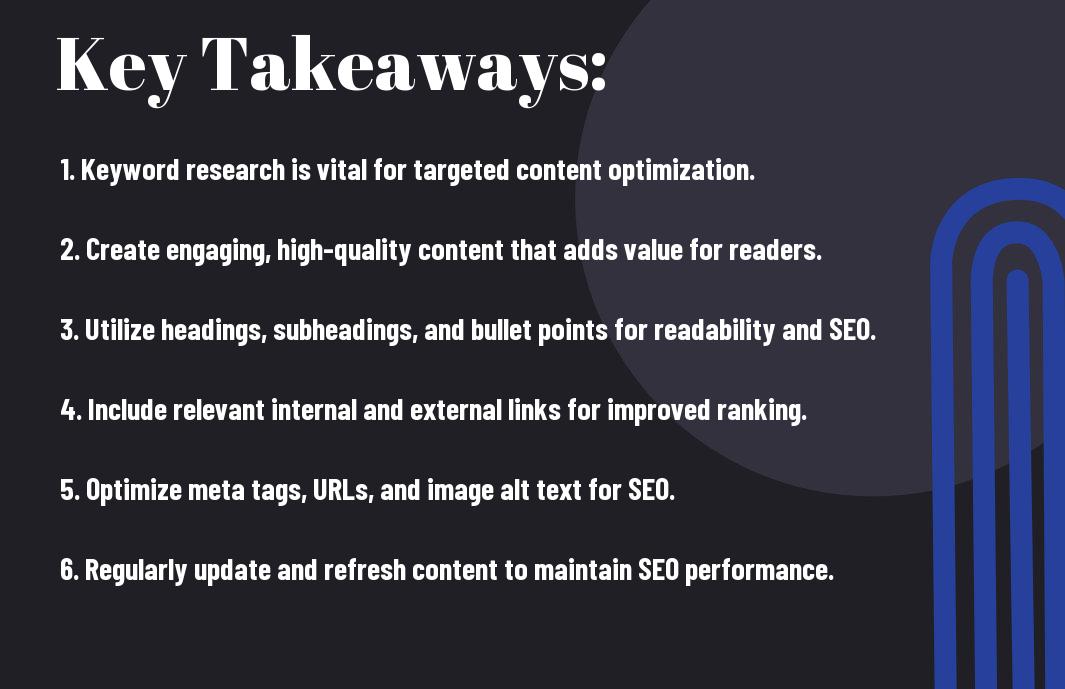
Taking this into account, it is crucial for website owners and bloggers to understand the best practices for creating SEO optimized content. By incorporating relevant keywords, creating high-quality and engaging content, optimizing meta tags, and understanding the importance of internal and external linking, you can improve your website’s visibility and attract more organic traffic. These strategies will not only enhance your search engine rankings but also establish your website as a credible source of information in your niche.
Consistency is key when it comes to content creation for your website blog. It is important to regularly update your blog with fresh and informative content that resonates with your target audience. By staying up-to-date with the latest SEO trends and algorithms, you can stay ahead of the competition and maintain a strong online presence. Do not forget, content is king, and by following these best practices, you can effectively optimize your content for search engines while providing value to your readers.
In essence, mastering the art of SEO optimized content writing is important for the success of your website blog. By following the best practices outlined in this guide, you can create content that not only ranks well in search engines but also engages and informs your audience. Remember to analyze your results, make adjustments as needed, and stay committed to providing valuable content that resonates with your readers. With dedication and a strategic approach, you can elevate your website’s visibility and attract a steady stream of organic traffic.
FAQ
Q: Why is SEO optimized content important for website blogs?
A: SEO optimized content helps improve your website’s visibility on search engines, driving more organic traffic to your blog.
Q: What are the best practices for SEO optimized content writing?
A: The best practices include conducting keyword research, writing high-quality and engaging content, optimizing meta tags, and building backlinks.
Q: How can keyword research improve SEO for blog content?
A: Keyword research helps you understand what terms your target audience is searching for and allows you to strategically incorporate those keywords into your content for better ranking.
Q: What is the significance of high-quality content in SEO?
A: High-quality content not only attracts readers but also earns backlinks from other websites, signaling to search engines that your content is valuable and authoritative.
Q: How should meta tags be optimized for SEO?
A: Meta tags, including meta titles and descriptions, should accurately describe the content on the page, incorporate relevant keywords, and entice users to click through to your blog.
Q: Why are backlinks important for SEO optimized content?
A: Backlinks from reputable websites act as upvotes for your content, signaling to search engines that your blog is a trusted source of information and improving your search rankings.
Q: How can I measure the success of my SEO optimized content writing efforts?
A: You can use tools like Google Analytics to track organic traffic, keyword rankings, and conversions to evaluate the effectiveness of your SEO strategies and make data-driven improvements.