

Most businesses understand the importance of Customer Relationship Management (CRM) in today’s competitive market. Implementing CRM software can be a game-changer when it comes to managing customer relationships and leads efficiently. A well-implemented CRM system can increase sales, improve customer retention, and boost overall customer satisfaction.
However, the process of implementing CRM can be daunting and challenging for many organizations. It requires a structured approach, proper training for employees, and ongoing support to ensure successful adoption. Failing to implement CRM effectively can result in lost leads, poor customer satisfaction, and ultimately, revenue loss.
By focusing on data accuracy, clear communication, and consistent follow-up, businesses can harness the power of CRM to improve their bottom line and build long-lasting customer relationships. This blog post will explore into the key strategies for implementing CRM successfully and reaping the benefits it has to offer.
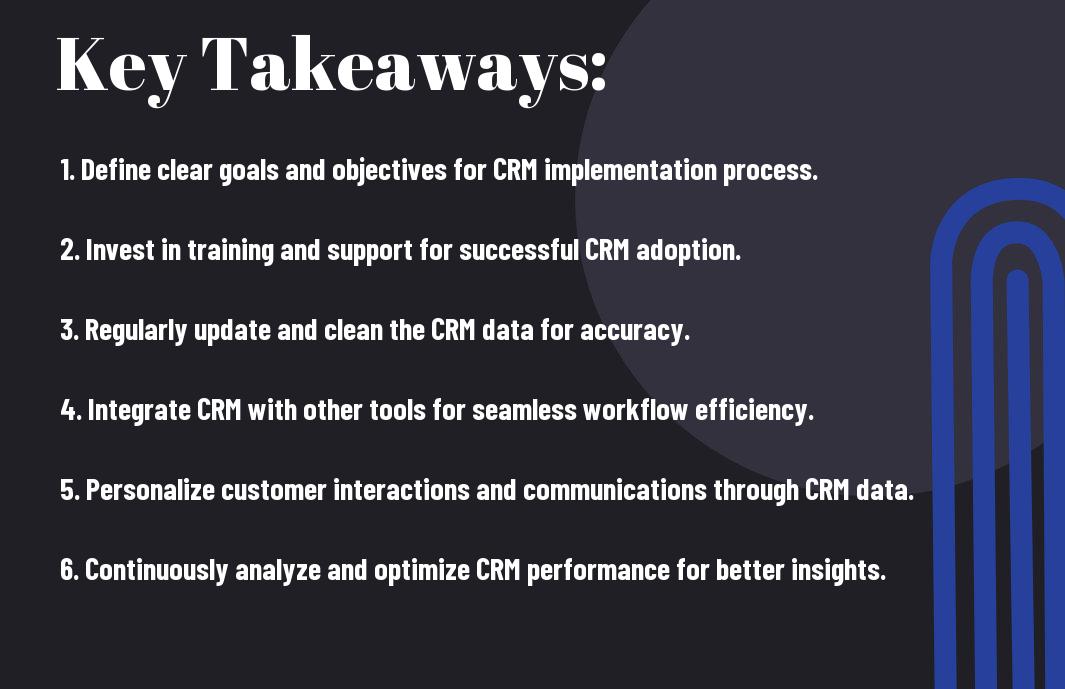
Key Takeaways:
- Define clear objectives: Before implementing CRM, define clear goals and objectives that align with your organization’s overall strategy.
- Customize CRM to fit your needs: Tailor the CRM system to meet your specific business requirements, processes, and customer interactions.
- Train employees properly: Ensure that your employees receive adequate training on how to use the CRM system effectively to maximize its benefits.
- Regularly update and maintain data: Keep customer data accurate and up-to-date to ensure the success of your CRM implementation.
- Integrate CRM with other systems: Integrate CRM with other tools and systems used in your organization to streamline processes and enhance efficiency.
- Provide excellent customer support: Utilize CRM to provide personalized and timely support to customers, building stronger relationships and increasing loyalty.
- Monitor and analyze performance: Use CRM data and analytics to track performance, identify trends, and make data-driven decisions to improve customer relationships and lead management.
Fundamentals of CRM
Little can be as crucial to a business’s success as effectively managing customer relationships. Customer Relationship Management (CRM) is a strategy that focuses on building and maintaining long-lasting relationships with customers. It involves utilizing technology to organize, automate, and synchronize sales, marketing, customer service, and technical support.
Definition of Customer Relationship Management
An effective CRM system is not just about collecting customer data; it’s about using that data to understand and anticipate customer needs. By analyzing customer interactions and feedback, businesses can improve the overall customer experience and strengthen customer loyalty. CRM is not only a tool or software but a business strategy that puts the customer at the center of the organization’s focus.
Core Objectives of CRM Systems
On a fundamental level, the core objectives of CRM systems are to improve customer satisfaction, enhance customer loyalty, and drive customer retention. By capturing and analyzing customer data across various touchpoints, businesses can personalize their interactions and tailor their products and services to meet individual customer needs. This, in turn, leads to increased customer satisfaction and loyalty.
Plus, CRM systems enable businesses to streamline their processes, optimize productivity, and increase sales and profitability. By providing a centralized database for customer information, businesses can better track and manage leads, opportunities, and customer interactions. This data-driven approach allows businesses to make informed decisions and implement targeted marketing strategies to maximize customer engagement and drive revenue growth.
Types of CRM: Operational, Analytical, and Collaborative
Operational CRM focuses on automating and improving customer-facing processes such as sales, marketing, and customer service. Analytical CRM, on the other hand, focuses on analyzing customer data to improve business decisions and strategies. Collaborative CRM emphasizes facilitating interactions and communication with customers across various channels.
- Operational CRM: Streamlining sales and marketing processes.
- Analytical CRM: Analyzing customer data for insights.
- Collaborative CRM: Improving customer communication and engagement.
- Thou, an integrated approach that combines operational, analytical, and collaborative CRM is imperative for businesses to effectively manage customer relationships and drive business growth.
Operational CRM systems focus on improving customer interactions across various channels, including email, phone, and social media. By automating repetitive tasks and providing a centralized database for customer information, businesses can enhance efficiency and effectiveness in managing customer relationships.
- Efficiency: Streamlining processes and workflows.
- Effectiveness: Improving interaction quality and customer satisfaction.
- Scalability: Adapting to business growth and increasing customer base.
- Thou, operational CRM systems play a crucial role in enabling businesses to deliver personalized customer experiences and build long-lasting relationships with customers.
Key Components of an Effective CRM
This ubiquitous approach includes organizational strategy, customer-focused processes, employee empowerment, and the innovative use of technology. With businesses moving towards customer-centric approaches, CRM has become a cornerstone of their success.
One
Types of CRM systems available include on-premise, cloud-based, and hybrid solutions. While cloud-based CRM offers flexibility and scalability, on-premise solutions provide more control and customization options. Hybrid solutions combine the best of both worlds, offering the benefits of both cloud and on-premise deployments.
Planning for CRM Implementation
Establishing CRM Goals and Objectives
Objectives: Not having clear goals and objectives in place when implementing a CRM system can lead to inefficiencies and missed opportunities. It is crucial to define what you aim to achieve with CRM, whether it’s improving customer satisfaction, increasing sales, or streamlining processes. By establishing specific, measurable, achievable, relevant, and time-bound goals, your organization can stay focused and track progress effectively.
Aligning CRM with Business Strategy
Establishing: Aligning CRM with your business strategy is paramount for a successful implementation. This involves integrating CRM activities with your overall business objectives and ensuring that the CRM system supports and enhances your strategic direction. By aligning CRM with business strategy, you can maximize the value of customer data and interactions to drive growth and profitability.
This alignment requires a thorough understanding of your business goals and how CRM can contribute to achieving them. By aligning CRM with your strategy, you can ensure that the system is tailored to meet the specific needs of your organization and deliver significant results.
Identifying Stakeholder Needs and Expectations
Planning: Identifying stakeholder needs and expectations is vital for a successful CRM implementation. Stakeholders can include employees, customers, partners, and executives who will interact with the CRM system. By understanding their requirements and priorities, you can tailor the CRM solution to meet their needs and ensure buy-in across the organization.
To effectively identify stakeholder needs and expectations, consider conducting interviews, surveys, and workshops to gather feedback. This information can then be used to inform the design and configuration of the CRM system, ensuring that it aligns with stakeholder expectations and drives engagement and adoption.
Data Management Strategies for CRM Deployment
Deployment: To ensure the success of your CRM deployment, you need robust data management strategies in place. This involves defining how data will be collected, stored, cleansed, and utilized within the CRM system. Effective data management is critical for maintaining data accuracy, consistency, and relevance, which are vital for making informed business decisions.
Aligning your data management strategies with your business objectives is key to leveraging the full potential of your CRM system. By implementing data quality standards, data governance processes, and data integration tools, you can ensure that your CRM system is powered by high-quality data that drives meaningful insights and actions.
Choosing the Right CRM Platform
Evaluating CRM Software Options
Choosing the right CRM software for your organization is a crucial decision that can impact how effectively you manage customer relationships and leads. With a plethora of options available in the market, it is necessary to evaluate each CRM software based on your specific business needs. Consider factors such as scalability, ease of use, customization capabilities, integration possibilities, and pricing when comparing different CRM solutions.
Look for CRM software that aligns with your business goals and provides the features and functionalities you require to streamline your customer relationship management processes. It’s important to involve key stakeholders from your organization in the evaluation process to ensure that the chosen CRM platform meets everyone’s requirements and expectations.
Ensure that the CRM software you select offers robust reporting and analytics tools to track and measure the effectiveness of your customer relationship management efforts. A CRM solution that provides insightful data and actionable insights can help you make informed business decisions and improve your overall customer satisfaction and retention rates.
On-Premise vs. Cloud-Based CRM Solutions
Cloud-based CRM solutions have gained popularity in recent years due to their flexibility, scalability, and cost-effectiveness. Unlike on-premise CRM systems that require a dedicated server infrastructure and IT support, cloud-based CRM solutions are hosted on the vendor’s servers and accessed through the internet, offering great convenience and accessibility.
Platforms such as Salesforce, HubSpot, and Zoho CRM are examples of cloud-based CRM solutions that provide a wide range of features and benefits, including automatic updates, improved security, and remote access. The scalability of cloud-based CRM systems allows businesses to easily adjust their subscription plans based on their changing needs without incurring significant upfront costs.
When considering between on-premise and cloud-based CRM solutions, it’s necessary to assess your organization’s IT capabilities, budget constraints, data security requirements, and scalability needs. While on-premise CRM solutions offer more control over data management and customization, cloud-based CRM systems provide greater flexibility and accessibility, making them ideal for businesses of all sizes.
Platform: Choosing the right CRM platform for your business is a critical decision that requires careful consideration of your organization’s unique requirements and objectives. Whether you opt for an on-premise or cloud-based CRM solution, ensure that the platform aligns with your business goals and can accommodate your current and future growth needs.
Understanding the Features and Functionalities
An in-depth understanding of the features and functionalities offered by different CRM platforms is necessary to make an informed decision. Look for CRM software that provides a comprehensive set of tools for managing customer relationships, tracking leads, automating marketing campaigns, and analyzing data to drive business success.
Consider features such as lead scoring, pipeline management, email marketing integration, customer service ticketing, and mobile accessibility when evaluating CRM platforms. The ability to customize the CRM system to suit your specific business processes and requirements is also a key factor to consider, as it can enhance user adoption and overall efficiency.
It’s advisable to invest time in exploring the demo versions of CRM platforms and seeking input from your team members to evaluate the ease of use and effectiveness of the features. A CRM platform that is intuitive, user-friendly, and offers seamless integration with your existing tools and systems can greatly improve your team’s productivity and customer satisfaction levels.
Integration with Existing Systems and Data Migration
Options for seamless integration with your existing systems and easy data migration capabilities are crucial considerations when selecting a CRM platform. A CRM solution that can effortlessly integrate with your email marketing software, ERP system, and other business tools can streamline your operations and provide a unified view of customer data across all touchpoints.
Ensure that the CRM platform you choose offers robust data migration tools and support to transfer your existing customer data accurately and securely. Data accuracy and consistency are vital for maintaining strong customer relationships and making informed business decisions, so choose a CRM solution that prioritizes data integrity and migration efficiency.
Another key aspect to consider is the long-term scalability and compatibility of the CRM platform with your evolving business needs. Look for a CRM solution that offers easy customization options, API integrations, and future-proof features to support your growth and expansion plans without causing disruptions to your existing processes.
Cost-Benefit Analysis and ROI Forecasting
One of the crucial steps in selecting a CRM platform is conducting a comprehensive cost-benefit analysis and ROI forecasting to understand the potential return on investment and long-term value of the chosen solution. Consider the upfront costs, ongoing subscription fees, implementation expenses, training costs, and potential savings or revenue increase that the CRM platform can deliver.
Evaluating the benefits of improved customer relationships, streamlined sales processes, increased lead conversions, and enhanced marketing campaigns against the costs of implementing and maintaining the CRM platform can help you make a well-informed decision. Calculate the projected ROI based on key performance indicators and benchmarks to assess the efficiency and effectiveness of the CRM solution in meeting your business objectives.

CRM Implementation Process
Preparing the Implementation Plan
All successful CRM implementations start with a well-thought-out plan. It is crucial to involve key stakeholders from various departments in this phase to gather requirements, set objectives, and define success metrics. Any gaps in the existing processes need to be identified, and a roadmap for the implementation should be established. Clear timelines, budget allocation, and resource planning are crucial components of the implementation plan to ensure a smooth and successful roll-out of the CRM system.
Having a detailed implementation plan not only streamlines the process but also helps in mitigating risks and avoiding potential roadblocks. By outlining the steps to be taken and setting realistic expectations, the implementation plan serves as a guiding tool throughout the CRM implementation journey.
Regular reviews and updates to the implementation plan as the project progresses are necessary to adapt to any unforeseen challenges or changes in the business environment. Effective communication of the plan to all stakeholders ensures alignment and commitment, fostering a collaborative approach towards achieving CRM implementation goals.
Team Composition and Assigning Responsibilities
One of the critical success factors in CRM implementation is the composition of the implementation team and the clear assignment of responsibilities. The team should comprise individuals from different departments who bring diverse skills and perspectives to the table. Each team member’s roles and responsibilities should be clearly defined to avoid confusion and overlap.
Assigning a dedicated project manager to oversee the implementation process and serve as the main point of contact for all stakeholders is crucial. This individual should possess strong leadership skills, project management experience, and a deep understanding of the organization’s goals and processes. Effective delegation and regular follow-ups on tasks ensure accountability and progress tracking.
Team members should be committed to the project’s success and actively participate in meetings, training sessions, and testing phases. Collaboration and teamwork among the implementation team members are key to overcoming challenges and ensuring a successful CRM implementation.
Training Staff on the New CRM System
Process of training staff on the new CRM system is crucial for user adoption and overall success of the implementation. Training sessions should be tailored to different user groups based on their roles and the functionalities they will be using. Providing hands-on training, online resources, and continuous support post-implementation are crucial for a smooth transition to the new CRM platform.
Composition of training materials should be clear, concise, and easy to understand to cater to users with varying levels of technical expertise. Regular feedback sessions and assessments can help identify any gaps in understanding and address them promptly. Investing time and resources in comprehensive training programs is key to maximizing the benefits of the new CRM system.
The continuous training and upskilling of staff ensure that they make the most of the CRM system’s features and capabilities. Encouraging a culture of learning and adaptation within the organization leads to a more efficient and productive use of the CRM platform, ultimately driving better customer relationships and business outcomes.
Customization and Configuration of the CRM Platform
On the customization and configuration front, organizations must align the CRM platform with their unique business processes and requirements. Customizing the system to match the specific needs of different departments and user roles enhances user experience and drives user adoption. Customization should be done keeping scalability and flexibility in mind to accommodate future business growth and changes.
Organizations should leverage the expertise of CRM consultants or internal CRM specialists to configure the system settings, workflows, and integrations effectively. Customization of dashboards and reports can provide valuable insights to users and support data-driven decision-making. Regular reviews and updates to the customization settings are necessary to ensure the CRM platform remains aligned with evolving business needs.
Platform that is well-customized and configured not only enhances user productivity and satisfaction but also enables organizations to extract maximum value from their CRM investment. Continuous optimization of the CRM platform based on user feedback and data analytics helps in improving business processes and gaining a competitive edge in the market.
User Adoption and Change Management
Once again, one of the critical factors for successful CRM implementation is user adoption and change management. Organizations often face challenges when employees resist adopting a new CRM system due to various reasons such as fear of change, lack of understanding of the benefits, or simply a preference for the familiar. Overcoming resistance to change is imperative to ensure the CRM system’s effectiveness and maximize the return on investment.
Overcoming Resistance to Change
Adoption: To overcome resistance to change, organizations need to involve employees in the process from the beginning. Communication, training, and ongoing support are key components of a successful change management strategy. Leaders must communicate the reasons for implementing CRM clearly, address any concerns or uncertainties, and demonstrate the benefits of the new system. Training should be provided to equip employees with the necessary skills to use the CRM effectively. Ongoing support and feedback mechanisms help address any issues or challenges that arise during the transition period.
Communication Strategies to Engage Employees
One: Communication is key to engaging employees and gaining their buy-in for the new CRM system. Organizations can utilize multiple channels such as emails, intranet announcements, team meetings, and one-on-one discussions to keep employees informed and involved throughout the implementation process. Leadership should communicate regularly about the progress, address any concerns, and celebrate small victories to keep employees motivated and engaged.
A: Furthermore, involving employees in the decision-making process and seeking their feedback can help in creating a sense of ownership and accountability towards the CRM system. By soliciting input from end-users, organizations can identify potential issues early on and tailor the CRM system to meet the specific needs of different departments or teams.
Monitoring User Adoption and Providing Ongoing Support
Resistance: Monitoring user adoption and providing ongoing support are crucial for the long-term success of the CRM system. Organizations can track user engagement, usage metrics, and feedback to identify any trends or areas that require improvement. By proactively addressing issues and providing additional training or resources as needed, organizations can ensure that employees continue to use the CRM system effectively.
Providing: Regular check-ins, surveys, and focus groups can help in gathering feedback from users and addressing any concerns promptly. Additionally, creating a support system with dedicated CRM champions or super-users can provide ongoing assistance to employees, answer questions, and promote best practices for using the CRM system. By fostering a culture of continuous learning and improvement, organizations can drive user adoption and maximize the benefits of the CRM system.
Managing Customer Data Effectively
Ensuring Data Quality and Integrity
Quality customer data is the lifeblood of any CRM system. Many organizations face challenges with duplicate, outdated, or inaccurate data which can lead to poor decision-making and lost opportunities. To ensure data quality and integrity, it is vital to implement robust data validation processes, establish data governance policies, and conduct regular data cleansing activities. By maintaining clean and accurate customer data, organizations can optimize their marketing efforts, improve customer satisfaction, and drive business growth.
Data Privacy and Compliance Standards
An integral part of managing customer data effectively is ensuring compliance with data privacy regulations such as GDPR and CCPA. For instance, organizations need to obtain explicit consent from customers before collecting and using their data, provide mechanisms for data access and deletion, and implement security measures to protect sensitive information. Non-compliance with these standards can result in hefty fines, loss of trust, and damage to reputation.
For instance, a data breach that compromises customer data can have severe financial and legal implications for an organization. Therefore, it is crucial to invest in robust data security measures, conduct regular audits, and provide training to employees on data privacy best practices.
Strategies for Data Analysis and Utilization
Any CRM strategy is incomplete without a focus on data analysis and utilization. By leveraging customer data effectively, organizations can gain valuable insights into customer behavior, preferences, and trends. This data can be used to personalize marketing campaigns, improve customer service, and drive customer retention. Implementing data analytics tools and techniques can help organizations make informed decisions and stay ahead of the competition.
Building a Single Customer View for Enhanced Service Delivery
Data silos can hinder organizations from delivering seamless and personalized customer experiences. Enhanced service delivery requires a unified view of customer data across all touchpoints. By integrating data from various sources such as sales, marketing, and customer service, organizations can create a holistic view of each customer. This single customer view enables organizations to deliver tailored services, anticipate customer needs, and build long-lasting relationships.
Maximizing Lead Management with CRM
Unlike What is CRM process? 5 steps + main components, effective lead management is crucial for businesses to convert prospects into customers successfully. By utilizing a CRM system, organizations can optimize lead management processes and improve sales performance. Let’s examine into how CRM can help maximize lead management efficiency.
Lead Generation and Capture
Maximizing lead generation and capture through CRM involves leveraging various tools and strategies to attract potential customers and gather their information. CRM systems provide businesses with the ability to create lead capture forms on their websites, track website visitor activity, and integrate with marketing automation tools to generate leads effectively. By centralizing lead information in a CRM system, businesses can streamline lead management processes and ensure no lead is overlooked.
Lead Qualification and Scoring Models
Any successful lead management strategy involves qualifying leads based on predefined criteria and implementing scoring models to prioritize high-value leads. Through CRM, businesses can establish lead qualification parameters, such as demographics, firmographics, and engagement levels, to identify the most promising leads. Scoring models help rank leads based on their likelihood to convert, allowing sales teams to focus their efforts on leads with the highest potential.
Another important aspect of lead qualification and scoring models is aligning sales and marketing teams on lead definitions and criteria. By establishing clear communication and collaboration between the two departments, businesses can ensure a seamless lead management process and improve conversion rates. Additionally, regular evaluation and refinement of lead qualification and scoring models based on feedback and data analysis are key to enhancing lead management effectiveness.
Nurturing Leads through CRM Workflows
Capture the power of lead nurturing through CRM workflows to guide leads through the sales funnel effectively. By setting up automated email campaigns, personalized messaging, and targeted interactions based on lead behavior, businesses can cultivate relationships with prospects and move them closer to conversion. CRM workflows enable continuous engagement with leads, providing them with valuable content and touchpoints to build trust and loyalty.
Generation Engage with leads at every stage of the buyer’s journey by delivering relevant and timely information through CRM workflows. By segmenting leads based on their interests and actions, businesses can tailor their communication and content to address specific needs and pain points. Leveraging CRM workflows for lead nurturing can significantly impact conversion rates and drive revenue growth for businesses.
Integrating Sales and Marketing Efforts within CRM
Scoring Establish a streamlined process for integrating sales and marketing efforts within CRM to ensure alignment and collaboration between the two teams. By sharing lead information, feedback, and insights within the CRM system, sales and marketing teams can work together cohesively to drive lead generation and conversions. Utilizing CRM analytics and reporting capabilities, businesses can track the effectiveness of their sales and marketing strategies and make data-driven decisions to optimize performance.
Lead By fostering a culture of collaboration and transparency between sales and marketing teams within the CRM system, businesses can enhance lead management practices and achieve greater success in converting leads into customers. Aligning sales and marketing efforts within CRM is important for maximizing the ROI of lead generation activities and boosting overall business growth.
Measuring CRM Success
For any organization implementing a CRM system, measuring success is crucial to understand the impact it has on managing customer relationships and leads. By defining key performance indicators, collecting and interpreting CRM analytics, implementing continuous improvement through feedback loops, and utilizing techniques for long-term CRM evaluation, businesses can effectively measure the success of their CRM efforts.
Key Performance Indicators for CRM
Performance indicators such as customer acquisition cost, customer retention rate, lead conversion rate, and customer lifetime value are necessary in evaluating the effectiveness of CRM initiatives. These metrics provide insights into how well the organization is acquiring, retaining, and nurturing customers over time.
Collecting and Interpreting CRM Analytics
Analytics play a significant role in measuring CRM success. By collecting data on customer interactions, sales performance, and marketing efforts, businesses can gain a deeper understanding of customer behavior and preferences. This data can then be analyzed to identify trends, patterns, and opportunities for improvement.
For instance, analyzing customer feedback and complaints can help organizations identify areas of dissatisfaction and implement strategies to address these issues, ultimately enhancing the overall customer experience.
Continuous Improvement through Feedback Loops
Measuring CRM success should not be a one-time effort but an ongoing process. Implementing feedback loops where customer feedback is collected, analyzed, and used to make continuous improvements is necessary. By listening to customer needs and preferences, organizations can adapt their CRM strategies to better meet customer expectations and enhance relationships.
With a focus on continuous improvement, businesses can identify areas for growth and innovation, leading to increased customer satisfaction and loyalty.
Techniques for Long-term CRM Evaluation
Continuous evaluation of CRM efforts is key to long-term success. By collecting data over time and analyzing trends, businesses can identify areas where the CRM system is performing well and areas that need improvement. Techniques such as ROI analysis, customer segmentation, and predictive modeling can provide valuable insights into the effectiveness of CRM strategies.
Collecting feedback from various touchpoints, including sales, marketing, and customer service, can help organizations gain a holistic view of customer interactions and identify opportunities for enhancement.
Advanced CRM Strategies and Trends
To effectively manage customer relationships and leads, businesses must stay ahead of the curve with advanced CRM strategies and trends. Below are some key strategies and trends in CRM that can help businesses optimize their customer interactions and drive growth:
- Leveraging AI and Machine Learning in CRM
- To predict future trends and customer preferences accurately, businesses can leverage advanced analytics tools that offer predictive modeling capabilities
- The insights derived from predictive analytics enable businesses to segment their customer base effectively and personalize interactions, leading to higher conversions and customer satisfaction
- Plus, by continuously refining models and adapting strategies based on predictive analytics, businesses can stay agile and responsive to evolving customer needs and market dynamics
| On one hand | AI and machine learning technologies allow businesses to analyze vast amounts of customer data to gain actionable insights |
| On the other hand | Automating tasks like lead scoring, personalized recommendations, and predictive analytics can help businesses target the right customers with the right message at the right time |
The Role of CRM in Multichannel Customer Engagement
Advanced CRM systems play a crucial role in enabling businesses to engage with customers across multiple channels seamlessly. By integrating customer data from various touchpoints, businesses can deliver personalized experiences and consistent messaging, regardless of the channel.
Having a unified view of customer interactions allows businesses to anticipate customer needs and preferences, providing timely and relevant support or offers. This level of engagement can lead to increased customer satisfaction, loyalty, and ultimately, business growth.
Moreover, advanced CRM tools enable businesses to track customer journeys across channels and optimize marketing strategies based on real-time data insights. This ability to adapt and personalize communications fosters stronger relationships with customers and enhances overall brand perception.
Predictive Analytics and Customer Behavior Modeling
To gain a competitive edge, businesses are increasingly turning to predictive analytics and customer behavior modeling within their CRM systems. By analyzing historical data and identifying patterns, businesses can anticipate future customer behavior and tailor their strategies accordingly.
To wrap up
On the whole, implementing CRM systems can bring significant benefits to businesses in effectively managing customer relationships and leads. By leveraging CRM tools, companies can streamline their sales processes, track customer interactions, and personalize their marketing strategies. This results in improved customer satisfaction, increased sales, and ultimately, higher revenue. However, it is crucial for businesses to carefully plan and execute their CRM implementation to ensure success.
Effective CRM implementation requires thorough research, proper training, and ongoing support for employees. It is imperative for businesses to align their CRM strategy with their overall business goals and objectives to maximize its potential. Additionally, companies must regularly evaluate and refine their CRM processes to adapt to changing market trends and customer preferences. By continuously improving their CRM systems, businesses can stay ahead of the competition and drive long-term growth.
Hence, when implemented correctly, CRM can revolutionize how businesses manage their customer relationships and leads. By investing in the right tools and strategies, companies can create seamless customer experiences, build loyalty, and drive repeat business. With a customer-centric approach and a commitment to continuous improvement, businesses can unlock the full potential of CRM and achieve sustainable success in today’s competitive marketplace.
FAQ
Q: What is CRM?
A: CRM stands for Customer Relationship Management. It is a strategy for managing interactions and relationships with potential and existing customers.
Q: Why is implementing CRM important?
A: Implementing CRM is important because it helps businesses better understand their customers, improve relationships, increase sales, and ultimately, drive growth.
Q: What are the key benefits of implementing CRM?
A: Key benefits of implementing CRM include enhanced customer satisfaction, improved communication, streamlined processes, increased efficiency, and better decision-making based on data.
Q: How can CRM help in managing customer relationships effectively?
A: CRM helps in managing customer relationships effectively by centralizing customer data, tracking interactions, segmenting customers for targeted marketing, and providing insights for personalized engagement.
Q: What are some common features of a CRM system?
A: Common features of a CRM system include contact management, lead management, sales pipeline tracking, email integration, reporting and analytics, and automation of tasks.
Q: How can businesses successfully implement CRM?
A: To successfully implement CRM, businesses should define their goals, involve all stakeholders, choose the right CRM system, provide training to employees, customize the system to fit their needs, and continuously evaluate and improve their CRM strategy.
Q: What are some best practices for managing leads effectively with CRM?
A: Best practices for managing leads effectively with CRM include capturing leads from multiple sources, assigning leads promptly, nurturing leads through targeted communication, tracking lead interactions, and analyzing lead performance to optimize conversions.