

Loans can be a powerful tool for small businesses looking to expand, but without effective marketing strategies, reaching the right audience can be a challenge. In today’s digital age, Pay-Per-Click (PPC) advertising can be a game-changer, providing targeted visibility and measurable results. Our step-by-step guide will navigate you through the process of creating a successful PPC advertising campaign tailored specifically for small business loans. From keyword research to ad creation and monitoring performance, this guide will help you maximize your marketing efforts and reach potential borrowers effectively. For more in-depth marketing strategies for small businesses, check out our Small Business Marketing: A Step-by-Step Guide to Grow…
Key Takeaways:
- Identifying Target Audience: Understand the demographics, behavior, and interests of your target audience to create relevant PPC ads.
- Keyword Research: Conduct thorough keyword research to identify the most relevant keywords for your small business loan campaign.
- Compelling Ad Copy: Create engaging and compelling ad copy that highlights the benefits of your small business loans to attract clicks.
- Landing Page Optimization: Ensure that your landing pages are optimized for conversions, with clear calls-to-action and relevant information.
- Tracking and Analysis: Use tracking tools to monitor the performance of your PPC campaign and make data-driven decisions for optimization.
- Budget Management: Set a realistic budget for your PPC campaign and monitor spending to ensure maximum ROI for your small business loans.
- Continuous Optimization: Regularly review and optimize your PPC campaign by testing different ad variations, keywords, and targeting strategies to improve results.
Preliminary Steps
Identifying Your Target Audience
There’s no successful PPC campaign without a clear understanding of your target audience. Who are you trying to reach with your small business loan offers? Consider factors like age, income level, industry, and pain points when identifying your ideal customers. By segmenting your audience, you can tailor your ad messaging to resonate with their specific needs and increase your chances of conversion.
Setting Clear Campaign Objectives
For a successful PPC campaign for small business loans, setting clear campaign objectives is crucial. Define what you want to achieve with your ads, whether it’s increasing website traffic, generating leads, or boosting loan applications. Your objectives should be specific, measurable, achievable, relevant, and time-bound (SMART). Setting clear campaign objectives will guide your strategy and help you track the success of your campaign effectively.
Crafting Your PPC Campaign
Choosing the Right Types of PPC Ads
Any successful PPC campaign begins with selecting the right types of ads to reach your target audience effectively. Understanding the different ad formats and their benefits will help you make informed decisions on where to allocate your budget. Text ads, display ads, and shopping ads are common choices for small businesses offering loans. Thou, it’s vital to test and optimize your ad types to maximize ROI.
| Text Ads | Display Ads |
| Shopping Ads | |
Keyword Research and Selection Tips
Crafting a successful PPC campaign also involves right keyword research and selection. Identify relevant keywords with high search volume and low competition to attract quality leads. Utilize tools like Google Keyword Planner and SEMrush to discover popular search terms in the small business loan niche. This step is crucial in optimizing your ad’s visibility and driving traffic to your website. This ensures that your campaign targets the right audience and increases the chances of conversions.
- Relevant Keywords
- Search Volume
- Low Competition
- Google Keyword Planner
- SEMrush
Managing and Optimizing Your Campaign
Step-by-Step Campaign Setup
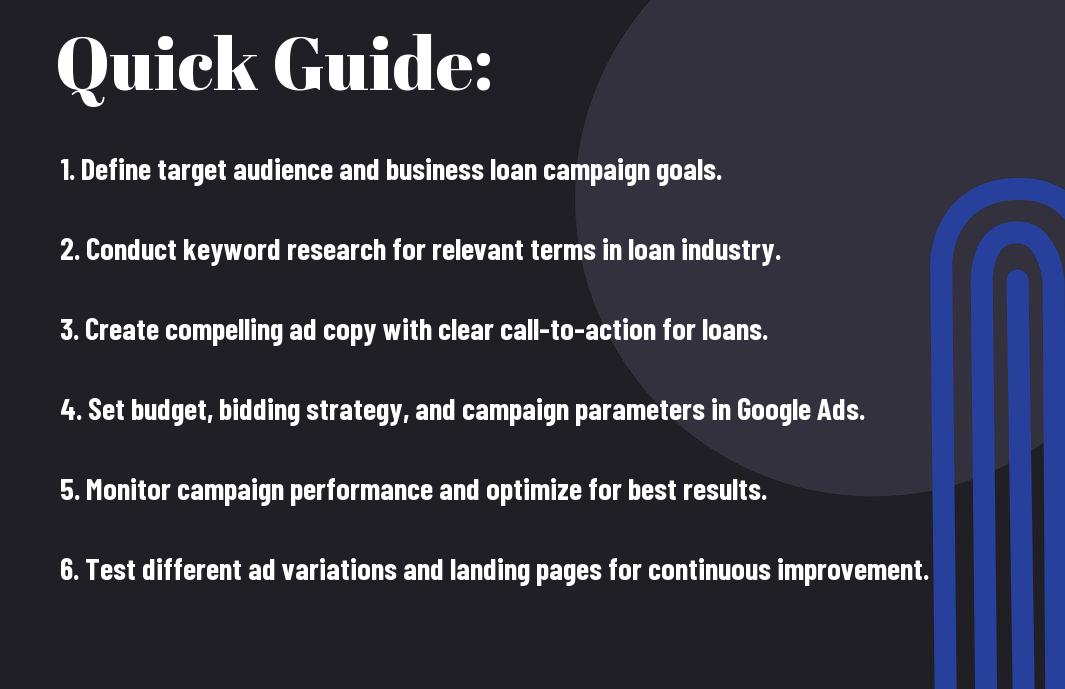
For a successful PPC advertising campaign for small business loans, a well-thought-out setup is crucial. Follow this step-by-step guide to ensure your campaign gets off to a strong start:
| Research Keywords | Create Compelling Ad Copy |
| Set Budget and Bidding Strategy | Design Landing Pages |
Continuous Monitoring and Optimization
Even after your campaign is up and running, the work doesn’t stop. Continuous monitoring and optimization are key to ensuring your PPC campaign remains effective. Keep a close eye on key performance metrics such as click-through rates, conversion rates, and cost per conversion.
A regular analysis of your campaign’s performance will help identify areas for improvement. Adjust your bidding strategy, ad copy, and keywords based on the data to maximize your ROI. Test different variations to see what resonates best with your target audience and be prepared to make adjustments accordingly.
Evaluating Campaign Performance
Key Performance Indicators (KPIs)
If you want to measure the success of your PPC advertising campaign for small business loans, you need to pay close attention to Key Performance Indicators (KPIs). These metrics will provide crucial insights into how your campaign is performing and where improvements can be made. Some necessary KPIs to monitor include click-through rate (CTR), conversion rate, cost per acquisition (CPA), and return on investment (ROI). By tracking these metrics regularly, you can make data-driven decisions to optimize your campaign for better results.
Learning from Campaign Data
Performance data from your PPC advertising campaign is a goldmine of valuable information that can help you fine-tune your strategies for small business loans. By analyzing the campaign data, you can identify trends, understand customer behavior, and pinpoint areas of improvement. Look for patterns in the data and adjust your targeting, messaging, and bidding strategies accordingly. Regularly monitoring and learning from your campaign data will enable you to adapt and optimize your PPC campaign for maximum success.
Advanced PPC Techniques and Considerations
Many small business owners are looking to maximize their PPC advertising efforts to stand out in the competitive small business loan market. To achieve success, it is crucial to leverage advanced PPC techniques and consider various factors that can impact the effectiveness of your campaigns.
- Leveraging Retargeting and Remarketing
Understanding the Pros and Cons of PPC for Small Business Loans
Retargeting
Leveraging Retargeting and Remarketing
Any small business looking to increase conversions and ROI from their PPC advertising campaigns should consider implementing retargeting and remarketing strategies. By targeting users who have previously visited your website or interacted with your ads, you can significantly improve conversion rates. Retargeting allows you to stay top of mind with potential customers and drive them back to your site to complete a desired action, such as filling out a loan application.
Understanding the Pros and Cons of PPC for Small Business Loans
Pertaining to using PPC advertising for small business loans, it’s important to weigh the pros and cons to make informed decisions about your campaign strategies. Here is a breakdown of the key advantages and disadvantages:
| Pros | Cons |
| Immediate visibility and traffic | Cost can add up quickly |
| Precise targeting options | Competition from larger companies |
| Ability to track and measure results | Requires ongoing optimization and management |
| Potential for high conversion rates | Click fraud and ad blockers can impact performance |
By carefully considering these pros and cons, small business owners can make informed decisions about their PPC advertising strategies and maximize their chances of success in the competitive small business loan market.
To wrap up
Hence, following this 5-step guide to creating a successful PPC advertising campaign for small business loans can significantly boost your chances of reaching your target audience, driving conversions, and ultimately increasing your business’s profitability. For more tips on improving your pay-per-click (PPC) strategy – Marketing, check out this resource. Do not forget, continuous monitoring, testing, and optimization are key to staying competitive in the digital advertising landscape. By implementing these strategies effectively, you can achieve long-term success and growth for your small business loan business.
FAQ
Q: What is PPC advertising?
A: PPC (Pay-Per-Click) advertising is a digital marketing strategy where advertisers pay a fee each time their ad is clicked. It is a way of buying visits to your site, rather than attempting to “earn” those visits organically.
Q: Why is PPC advertising important for small business loans?
A: PPC advertising is crucial for small business loans as it allows you to reach a targeted audience actively searching for financial services. It helps in generating leads, increasing brand visibility, and driving conversions.
Q: What are the benefits of implementing a PPC advertising campaign for small business loans?
A: The benefits include targeted reach, measurable results, cost-effectiveness, immediate impact, and the ability to track and optimize performance in real-time.
Q: How can I create a successful PPC advertising campaign for small business loans?
A: Follow these 5 steps: 1. Set clear goals, 2. Identify your target audience, 3. Choose relevant keywords, 4. Create compelling ad copy, and 5. Monitor, analyze, and optimize your campaign regularly.
Q: What are some best practices for small business loan PPC advertising campaigns?
A: Some best practices include using ad extensions, A/B testing ad copy, optimizing landing pages, targeting specific locations, scheduling ads at peak times, and using negative keywords to refine your audience.
Q: How can I track the success of my PPC advertising campaign for small business loans?
A: You can track success through key performance indicators (KPIs) such as click-through rate (CTR), conversion rate, cost per acquisition (CPA), return on ad spend (ROAS), and overall return on investment (ROI).
Q: What should I do if my PPC advertising campaign for small business loans is not performing well?
A: If your campaign is not performing well, reassess your keywords, ad copy, targeting options, and landing pages. Make data-driven decisions, test different strategies, and consider seeking professional help to optimize your campaign.